Key takeaways
- The India–EU trade deal, concluded in January 2026, includes a mobility framework for students and professionals. It still has to be signed and brought into force.
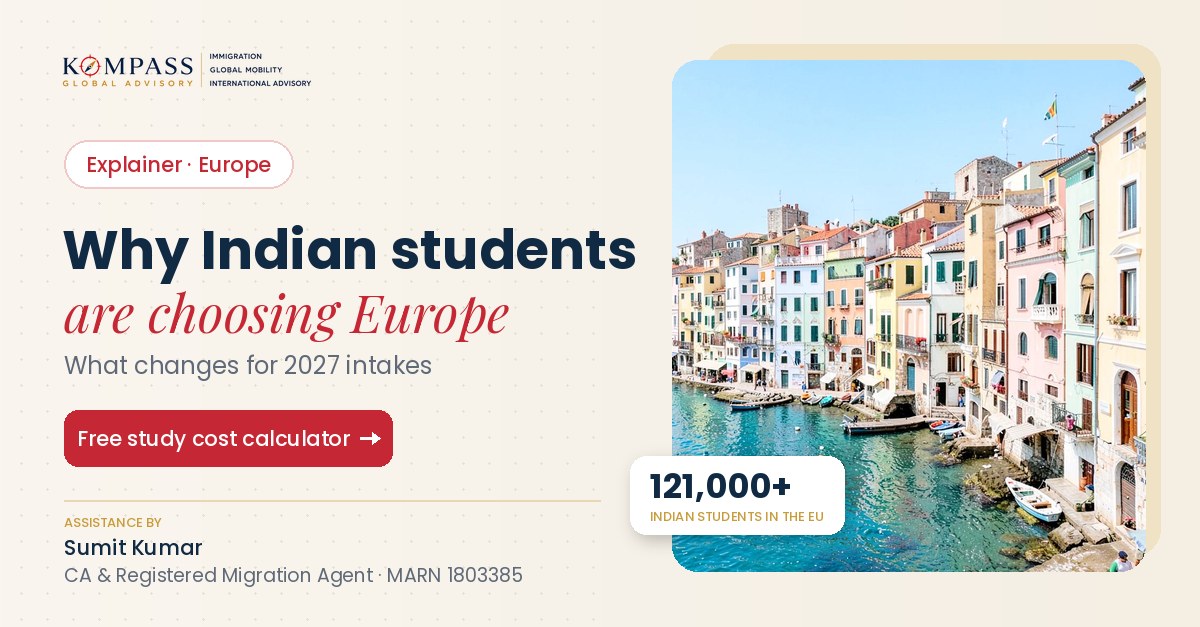
- More than 121,000 Indian students are already in the EU, and Dutch universities report sharp rises in Indian applications.
- Germany, Ireland, the Netherlands and France all let graduates stay on to look for work, from one year to 24 months.
- The UK Graduate visa falls to 18 months for applications from January 2027, which narrows the gap with Europe.
For years the UK, the US, Canada and Australia took most Indian students. That is changing. Tighter rules in those countries, lower fees in much of Europe and a new India–EU agreement are pushing more Indian families to look at Germany, Ireland, the Netherlands, France and Italy.
What the India–EU deal changes
India and the EU concluded their trade agreement in January 2026. Alongside trade, it includes a mobility framework. It has still to be signed and implemented, so treat it as direction of travel rather than rules you can rely on today.
- A continuing framework for Indian students to study in the EU and move on to post-study work.
- Clearer access for Indian professionals in IT, business, research and higher education, including intra-company transfers.
- Social security agreements with EU member states to be put in place within five years, so contributions are not lost when you move.
The EU Talent Pool
The EU Talent Pool regulation came into force on 1 June 2026. It will be an EU-wide platform that matches jobseekers from outside the EU with employers. The European Commission expects it to be fully operational by the end of 2027, so it is a reason to plan, not a route you can apply through yet.
Staying on after your degree
| Country | Time to look for work after graduating | Next step |
|---|---|---|
| Germany | Up to 18 months | EU Blue Card or skilled worker permit, then permanent residence |
| Ireland | Up to 24 months after a master's (12 months after a bachelor's) | Critical Skills or General Employment Permit |
| Netherlands | One-year search year | Highly skilled migrant permit |
| France | One-year temporary residence permit after a master's | Work permit or talent passport |
| United Kingdom | 18 months for applications from January 2027 (PhD: 3 years) | Skilled Worker visa |
The cost difference
Public universities in Germany charge little or no tuition for most courses, and France and Italy are low-cost at public institutions too. Ireland and the Netherlands cost more but often offer one-year or shorter master's courses. Your biggest cost in most of Europe is living expenses, which is where scholarships and part-time work help.
Who Europe suits
- Engineering, IT and science students who want low tuition: Germany.
- Students who want a one-year English-taught master's and time to find work: Ireland.
- Business, tech and design students who want English-taught courses: the Netherlands and France.
- Families on a tighter budget, especially with income-based grants: Italy.
What to do next
- 1Take our two-minute country quiz to see which countries fit your budget and goals.
- 2Check the real first-year cost in rupees with the study cost calculator.
- 3Look at the scholarships for your shortlist: deadlines for September 2027 start as early as November 2026.
- 4Book a free student counselling session to confirm your plan.
Work out what Europe would cost you
Tuition, living costs and the money you must show for the visa, in rupees.
General information only, not advice for your situation. Rules, fees and thresholds change; we confirm what applies at your consultation.
Frequently asked questions
Is the India–EU mobility agreement in force?
What is the EU Talent Pool?
Which European country is cheapest for Indian students?
Can I work in Europe after my degree?
Do I need to learn German or French?
Is Europe better than the UK now?
Official sources
- Business Today: India–EU FTA mobility provisions (28 January 2026)
- European Commission: EU Talent Pool
- Make it in Germany: EU Blue Card at a glance
- Deccan Herald: Indian students turn to Europe
General information only, current at the date shown. It is not immigration advice for your circumstances. Information on this site is general guidance only and not legal, migration or investment advice. Rules, fees and occupation lists change frequently — always confirm current requirements with the relevant government authority before acting.
Found this useful? Share it
Who will assist you
Sumit Kumar
Chartered Accountant & Australian Registered Migration Agent · MARN 1803385
I migrated from India to Melbourne as a skilled migrant in 2005 and became an Australian citizen in 2010, so I know first-hand what it takes to rebuild a career and a life in a new country — the paperwork and the waiting, and also the job search, the loneliness and the pressure of starting over far from home. Since 2013 I have advised individuals, families and businesses on migration and cross-border moves, combining migration casework with a Chartered Accountant's view of tax, funds and business structure.